




Starting as a music producer in Nepal can be challenging because income is rarely fixed, especially during the first few years. A beginner may work on small recording projects, assist in studios, create beats, or take freelance work while building the portfolio and industry connections needed to earn more.
The average music producer salary in Nepal is generally around NPR 25,000 to NPR 80,000 per month. In contrast, experienced producers can earn NPR 100,000 or more through studio work, freelance projects, commercial productions, and independent music. This guide explains salary ranges, factors affecting income, required skills, career opportunities, and practical ways to build a sustainable music production career.
In this blog
What Is the Average Music Producer Salary in Nepal?
The average music producer salary in Nepal is approximately NPR 25,000 to NPR 80,000 per month, depending on experience, skills, projects, employer, and professional reputation. Entry-level producers generally earn less, while experienced professionals can increase their income through freelance production, mixing, mastering, commercial projects, and independent work. Annual earnings can range from roughly NPR 300,000 to NPR 960,000 or more, depending on workload and income sources.
| Experience Level | Estimated Monthly Salary | Estimated Annual Income |
|---|---|---|
| Fresher/Entry-level | NPR 15,000–30,000 | NPR 180,000–360,000 |
| Junior/Mid-level | NPR 30,000–50,000 | NPR 360,000–600,000 |
| Experienced | NPR 50,000–80,000 | NPR 600,000–960,000 |
| Senior/Professional | NPR 80,000–150,000+ | NPR 960,000–1,800,000+ |
These figures are practical estimates rather than a fixed national salary scale because music production includes both salaried employment and project-based work. A producer who works with several artists, creates commercial music, sells beats, or accepts international projects may earn substantially more than someone working only in a single studio position.
Experienced producers often have several income sources, such as:
- Studio or production-house salary
- Freelance music production
- Beat production and licensing
- Mixing and mastering
- Film and television projects
- Advertising and commercial audio
- YouTube and digital content
- Independent music releases
- Remote projects for international clients
What Factors Affect Music Producer Salary in Nepal?
Music producer salary in Nepal depends mainly on experience, technical ability, project volume, location, reputation, specialization, and the ability to generate income from different types of work. Producers who combine creative skills with technical and business skills generally have more opportunities to negotiate higher rates. Salary can also change significantly between a full-time studio employee and an independent producer working on multiple projects.
- Years of experience: Experience helps producers handle complex projects and work independently.
- Production skills: Strong arrangement, recording, editing, mixing, and mastering skills can improve earning potential.
- Employer: Production houses, studios, media companies, and advertising agencies may offer different salary levels.
- Location: Kathmandu generally provides more opportunities because it concentrates studios, artists, media companies, and entertainment businesses.
- Projects: Producers working on larger commercial projects can earn more per assignment.
- Genre: Specializing in particular genres can help producers build a stronger reputation among relevant artists.
- Portfolio: A strong portfolio gives clients evidence of production quality before they hire you.
- Freelancing: Independent projects can supplement or exceed a regular salary.
- Networking: Relationships with singers, musicians, studios, filmmakers, and agencies can generate repeat projects.
- Software and equipment: Knowledge of professional DAWs, plugins, microphones, interfaces, and recording equipment improves production capability.
- Negotiation: Producers who clearly communicate pricing, revisions, deadlines, and deliverables can manage projects more profitably.
How Much Can a Beginner Music Producer Earn in Nepal?
A beginner music producer in Nepal can typically earn around NPR 15,000 to NPR 30,000 per month, although freelance and project-based income can vary considerably. Freshers often start by assisting experienced producers, working in recording studios, completing internships, or handling small independent projects while developing practical skills. The initial focus should be building reliable production ability and a portfolio rather than expecting a high salary immediately.
Common entry-level opportunities include:
- Recording studios: Assist with recording sessions, editing, arrangement, and basic production.
- Production houses: Support audio work for music, video, advertisements, and digital content.
- Media companies: Work with audio for television, online videos, podcasts, and other media.
- Music labels: Assist with artist recordings, music projects, and production tasks.
- Freelance projects: Produce beats, edit tracks, record vocals, or provide basic mixing services.
- Internships: Gain studio experience and learn professional workflows from senior producers.
A beginner who completes several real projects can develop practical experience much faster than someone who only studies production theory. Creating sample tracks, assisting other producers, and documenting completed projects can provide useful portfolio material when applying for paid positions.
How Can Music Producers Increase Their Earnings in Nepal?
Music producers can increase their earnings by improving technical skills, developing a strong portfolio, expanding their services, and building multiple income streams. Relying only on a fixed studio salary can limit earning potential, while combining employment with freelance or independent work can create additional opportunities. Producers should gradually move toward higher-value projects as their skills and reputation improve.
- Develop advanced production skills: Learn professional arrangement, sound design, recording,mixing, and mastering techniques so you can handle more complex projects.
- Master professional DAWs: Become highly comfortable with tools such as Ableton Live, FL Studio, Logic Pro, Pro Tools, or other commonly used production software.
- Build a strong portfolio: Create a collection of your best tracks that clearly demonstrates your production quality and range.
- Work across genres: Experience with different styles can help you serve more artists and increase the number of potential clients.
- Offer freelance services: Provide production, editing, beat-making, mixing, mastering, or recording services outside your regular employment.
- Sell beats: Create original beats and license or sell them to singers, rappers, content creators, and independent artists.
- Provide mixing and mastering: These specialized services can become additional revenue streams when you develop consistent technical quality.
- Build a personal brand: Share production work, behind-the-scenes content, tutorials, and finished projects on platforms where musicians and potential clients are active.
- Take commercial projects: Advertising, films, documentaries, digital campaigns, and branded content can provide higher-value production opportunities.
- Build multiple income streams: Combining studio employment, freelance services, beat sales, commercial work, and independent releases can make income more stable.
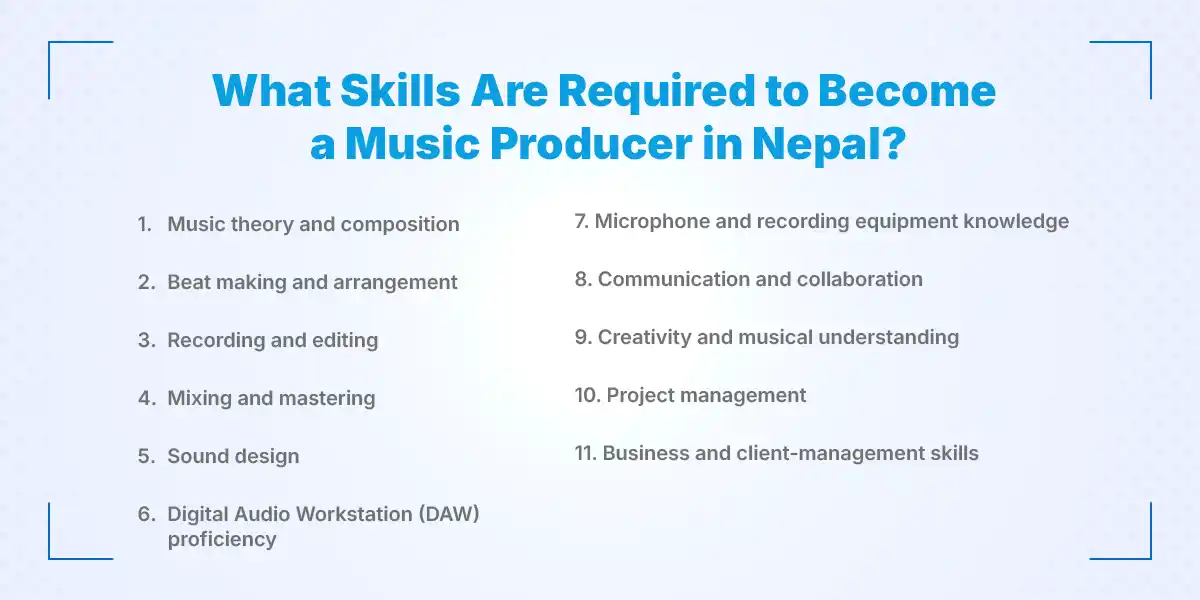
What Skills Are Required to Become a Music Producer in Nepal?
The key skills required to become a music producer in Nepal include music theory, beat making, recording, mixing, mastering, sound design, DAW proficiency, equipment knowledge, communication, creativity, project management, and client-management skills. Developing these skills helps producers create professional-quality music and work effectively with artists, studios, media companies, and freelance clients.
1. Music Theory and Composition
Music theory helps producers understand chords, scales, rhythm, melody, and song structure. Strong composition knowledge makes it easier to create original and well-structured music.
2. Beat Making and Arrangement
Beat making involves creating rhythms and instrumental patterns that support a song. Arrangement skills help producers organize vocals, instruments, transitions, and sections into a complete track.
3. Recording and Editing
Producers need recording skills to capture clean vocals and instruments using suitable microphones and studio equipment. Editing skills help remove unwanted noise, correct timing issues, and prepare tracks for mixing.
4. Mixing and Mastering
Mixing involves balancing vocals, instruments, effects, and frequencies to create a clear final track. Mastering prepares the completed mix for consistent playback across different devices and platforms.
5. Sound Design
Sound design allows producers to create, modify, and combine sounds for unique musical effects. It is especially useful when producing electronic music, film audio, advertisements, and digital content.
6. Digital Audio Workstation (DAW) Proficiency
A music producer should become highly comfortable with at least one professional DAW for recording, editing, arranging, and mixing music. Common DAWs include FL Studio, Ableton Live, Logic Pro, and Pro Tools.
7. Microphone and Recording Equipment Knowledge
Understanding microphones, audio interfaces, studio monitors, MIDI controllers, and other equipment helps producers create better recordings. Producers should also know how to select and position equipment according to the recording environment.
8. Communication and Collaboration
Music producers regularly work with singers, musicians, songwriters, engineers, and clients. Clear communication helps producers understand creative expectations, manage feedback, and complete projects smoothly.
9. Creativity and Musical Understanding
Creativity helps producers develop original sounds, arrangements, beats, and production ideas. A good producer should also understand the artist's musical style and improve the song without removing its identity.
10. Project Management
Project-management skills help producers organize recording sessions, production tasks, revisions, deadlines, and final deliveries. Good organization becomes especially important when managing several artists or commercial projects at the same time.
11. Business and Client-Management Skills
Business skills help producers set rates, negotiate projects, communicate deliverables, and manage payments professionally. Understanding basic contracts, music rights, licensing, and client expectations can also protect producers as they take on larger projects.
Where Can Music Producers Find Jobs in Nepal?
Music producers can find opportunities in recording studios, production companies, media organizations, advertising agencies, entertainment businesses, and freelance marketplaces. The strongest opportunities are often concentrated in Kathmandu, although digital platforms allow producers to work with artists and clients from other locations. Job seekers can also monitor platforms such as Kumari Job for relevant creative and media positions.
Potential workplaces include:
- Recording and music studios
- Music production companies
- Film and television production companies
- Advertising agencies
- Radio and media companies
- Entertainment companies
- YouTube and digital content production teams
- Freelance marketplaces
- Independent music projects
- Job portals such as Kumari Job
For salaried positions, candidates should prepare a resume that highlights technical skills, software knowledge, relevant experience, and completed projects. A portfolio link can be particularly valuable because employers can evaluate actual production work rather than relying only on written qualifications.
What Is the Career Scope of Music Production in Nepal?
The career scope of music production in Nepal is expanding across music, film, advertising, digital media, podcasts, online content, and freelance services. The growth of independent artists and digital platforms has created more ways for producers to work outside traditional recording studios. Producers who develop a recognizable style and strong professional network can also pursue international and remote projects.
Major career opportunities include:
- Nepali music production: Work with singers, bands, rappers, and independent musicians.
- Film and television: Produce background scores, songs, soundtracks, and other audio elements.
- Advertising: Create jingles, commercial music, voice-related audio, and branded sound.
- YouTube and social media: Produce music and audio for creators, channels, and digital campaigns.
- Podcast production: Record, edit, mix, and prepare podcast audio for publication.
- Freelancing: Work directly with clients on production, editing, mixing, and mastering.
- Independent production: Release original music or develop projects with independent artists.
- International work: Provide remote production services to clients outside Nepal.
- Personal branding: Build an audience through original music, production content, tutorials, and collaborations.
The career can become more financially attractive when producers stop depending on one type of client or project. A producer who develops both creative expertise and commercial awareness can move from small individual projects toward larger productions and recurring clients.
What Education or Training Is Needed to Become a Music Producer?
A formal degree is not always required to become a music producer because practical skills, production quality, and portfolio strength often carry significant weight. However, structured music-production training can shorten the learning curve and provide access to professional workflows, instructors, equipment, and practical projects.
Useful learning paths include:
- Formal music education: Study music theory, composition, audio engineering, or related subjects.
- Music production courses: Learn recording, arrangement, mixing, mastering, and DAW workflows.
- Certifications: Use relevant certifications to demonstrate structured training where appropriate.
- Workshops: Attend practical sessions led by experienced musicians, engineers, or producers.
- Online courses: Learn specific production techniques and software through structured digital training.
- Studio experience: Assist professionals and observe real recording and production workflows.
- Personal projects: Produce original tracks regularly to turn theoretical knowledge into practical ability.
- Portfolio development: Collect your strongest work and update it as your skills improve.
A producer should treat learning as an ongoing process because software, production techniques, plugins, and distribution methods continue to change. Practical experimentation is especially important because production decisions become easier when you have repeatedly solved real recording and mixing problems.
What Are the Best Practices for Building a Successful Music Production Career?
The best way to build a successful music production career is to combine strong creative skills with professional project management, networking, consistent learning, and a portfolio that demonstrates real ability. Producers should also understand their rates, deliverables, deadlines, ownership arrangements, and client expectations before starting paid work. This approach helps protect both the creative quality of a project and the producer's professional reputation.
- Keep learning: Practice new recording, arrangement, mixing, and sound-design techniques.
- Follow trends selectively: Understand popular sounds while developing an individual production identity.
- Upgrade equipment gradually: Improve microphones, interfaces, monitors, computers, and plugins according to actual project needs.
- Network professionally: Build relationships with singers, musicians, studios, filmmakers, agencies, and content creators.
- Maintain a portfolio: Keep your best completed tracks easy for potential clients or employers to access.
- Define rates clearly: Explain production fees, revision limits, delivery dates, and included services before beginning work.
- Meet deadlines: Reliable delivery can be as valuable to repeat clients as technical quality.
- Promote your work: Use professional social profiles and digital platforms to showcase completed projects.
- Understand music rights: Learn basic concepts such as ownership, licensing, credits, royalties, and usage permissions.
- Develop business skills: Learn budgeting, invoicing, negotiation, client communication, and project planning.
One practical improvement is to create different portfolio sections for different types of work, such as songs, commercial audio, mixing, and sound design. This allows potential clients to quickly see whether your experience matches their project instead of searching through unrelated examples.
Conclusion
Music production can offer a flexible creative career in Nepal, but earning potential depends heavily on what a producer can create, how consistently they deliver, and how effectively they turn skills into paid projects. Instead of focusing only on a starting salary, aspiring producers should build a strong portfolio, gain studio experience, develop professional relationships, and gradually add higher-value services.
The biggest opportunity comes from combining music production expertise with business skills and multiple income streams. If you are ready to build your career and explore relevant opportunities, check music and creative job opportunities on Kumari Job.
Frequently Asked Questions
Submit your comments

Get Our App On



What Is the Average Translator Salary in Nepal?
VIEW DETAILS
What Is the Average University Professor Salary in Nepal?
VIEW DETAILS
What Is the Average Talent Acquisition Specialist Salary in Nepal?
VIEW DETAILS.webp)
What Are the 5 Mistakes That Slow Down Hiring in Nepal?
VIEW DETAILS


Loading Comments...