




A fresh language graduate finishing a degree in English, Chinese, Japanese, or Korean often runs into the same wall: strong language skills, but no clear picture of what a translation career actually pays in Nepal. Job postings list vague terms like negotiable or as per company standard, leaving candidates unsure whether to accept an offer, negotiate harder, or look elsewhere entirely.
This guide answers that gap directly. It breaks down translator salaries in Nepal by experience level, explains the factors that push pay up or down, and outlines practical steps to move from an entry-level rate to a senior or freelance income that reflects real market value.
In this blog
What Is a Translator and What Does a Translator Do?
A translator is a language professional who converts written content from one language into another while preserving its original meaning, tone, and intent. Unlike an interpreter, who works with spoken language in real time, a translator works with text and has time to research, revise, and refine the final output. This distinction matters in Nepal's job market, where employers often list "translator" and "interpreter" as separate roles with different pay structures and skill requirements.
Translators in Nepal handle a wide range of daily tasks, including:
- Translating documents, contracts, and official reports
- Converting websites and digital content into target languages
- Reviewing and quality-checking translated material
- Proofreading and editing for grammar and clarity
- Preserving accuracy, tone, and cultural meaning across languages
- Using CAT tools and other translation software
- Maintaining strict confidentiality over sensitive documents
Translators commonly find work across several sectors in Nepal, including:
- Translation agencies
- NGOs and INGOs
- Government organizations and ministries
- Educational institutions
- Tourism and hospitality businesses
- International companies and embassies
- Media and publishing houses
- Freelance and remote translation platforms
What Is the Average Translator Salary in Nepal?
The average translator salary in Nepal generally falls between NPR 20,000 and NPR 60,000 per month, though top-tier specialists can earn more. Pay depends heavily on experience level, the language pair a translator works with, their area of specialization, and the type of employer they work for. Location also plays a role, since Kathmandu-based roles with international organizations tend to pay more than similar positions in smaller cities.
The table below outlines estimated monthly salary ranges by experience level:
| Experience Level | Estimated Monthly Salary |
|---|---|
| Fresher/Entry-Level | NPR 18,000–25,000 |
| Junior Translator | NPR 25,000–35,000 |
| Mid-Level Translator | NPR 35,000–50,000 |
| Experienced Translator | NPR 50,000–70,000 |
| Senior/Specialized Translator | NPR 70,000–100,000+ |
Translator salaries in Nepal rise steadily with experience, moving from roughly NPR 18,000 for freshers to NPR 100,000 or more for senior, specialized translators. Language rarity, subject-matter expertise, and employer type are the biggest variables that separate low earners from high earners in this field.
Entry-level translators are typically fresh graduates building foundational skills, often taking on general documents or basic content translation. Mid-level translators have usually accumulated two to four years of experience and can handle more complex material with less supervision. Experienced and senior translators often specialize in fields like law, medicine, or finance, and freelance translators occupy a separate category entirely, since their income depends on the volume and rate of projects they secure rather than a fixed monthly salary.
How Much Does a Translator Earn Per Month in Nepal?
Monthly translator earnings in Nepal vary significantly based on employment type rather than job title alone. A full-time employee at a translation agency or NGO receives a fixed monthly salary regardless of how many pages they translate in a given week. Freelancers, part-time translators, and project-based translators, by contrast, earn based on output, meaning their income can shift from one month to the next.
- Full-time employees: Fixed monthly salary with benefits, typically the most stable income structure
- Part-time translators: Lower fixed pay tied to reduced working hours, often combined with a second job
- Freelancers: Paid per word, per page, or per project, with earnings tied directly to workload
- Remote translators: Often work with international clients, sometimes earning in foreign currency
- Project-based translators: Paid a lump sum per assignment, common for large document or localization jobs
Freelance and project-based income tends to fluctuate more than salaried income because it depends on how many clients a translator secures and how consistently work flows in. A translator with three active clients in one month might have only one the next, which directly affects take-home pay. Building a steady pipeline of repeat clients is one of the most effective ways freelancers stabilize their monthly earnings over time.
What Factors Affect Translator Salary in Nepal?
Several interconnected factors determine how much a translator earns in Nepal, and understanding them helps job seekers negotiate more effectively. Experience remains the strongest predictor of salary, since employers pay a premium for translators who need minimal supervision and can handle complex material independently. Beyond experience, the following factors shape earning potential:
- Language: Less-common or high-demand language pairs, such as Japanese, Korean, or German, often command better pay than widely available pairs.
- Education: Relevant degrees, diplomas, or language certifications improve both employability and starting salary.
- Specialization: Legal, medical, technical, and financial translation typically pay more than general content translation
- Location: Kathmandu-based roles, especially with international organizations, generally offer higher pay than roles in smaller cities
- Employer: International organizations and specialized agencies often pay more than small local agencies
- Employment type: Full-time, freelance, contract, and remote roles each carry different earning structures and risk levels
- Technology skills: Familiarity with CAT tools and translation software increases productivity, which directly affects freelance earning capacity
What Skills Do You Need to Become a Translator in Nepal?
A successful translator in Nepal needs a combination of language mastery, technical proficiency, and professional discipline. Core skills include:
- Strong command of at least two languages
- Excellent grammar and vocabulary
- Writing and editing skills
- Cultural awareness and sensitivity
- Research skills for unfamiliar terminology
- Attention to detail
- Time management under deadlines
- Clear communication with clients or teams
- Subject-matter knowledge in one or more fields
- Computer literacy
- Familiarity with CAT and translation tools
- Ability to maintain strict confidentiality
Technical Skills and Tools
- Computer-assisted translation (CAT) tools, such as memoQ or SDL Trados, help translators work faster while maintaining consistency across large documents.
- Translation memory databases store previously translated segments, reducing repeated work and improving accuracy on recurring projects.
- Terminology management systems keep specialized vocabulary consistent, which matters most in legal, medical, and technical translation work.
- Proficiency in Microsoft Word, Google Docs, and basic document formatting rounds out the practical toolkit employers expect from any working translator.
How Can You Become a Translator in Nepal?
Becoming a translator in Nepal follows a fairly clear pathway, even for those starting with no prior industry experience. The general steps include:
- Choose your language pair based on personal strength and market demand
- Build strong proficiency in both the source and target languages
- Complete relevant education or formal language training
- Develop translation, editing, and proofreading skills through practice
- Learn industry-specific terminology in a chosen field
- Practice with real-world documents, even informally at first
- Create a translation portfolio showcasing sample work
- Apply for entry-level translation jobs at agencies or organizations
- Explore freelance and remote opportunities on global platforms
- Continue improving language and technical skills over time
Beginners do not need to target senior or highly specialized roles immediately. Building a portfolio through smaller projects, internships, or volunteer translation work for NGOs is a practical way to gain real experience before applying for higher-paying positions. Language proficiency certifications, such as JLPT for Japanese or TOPIK for Korean, can also strengthen a candidate's profile and justify a higher starting salary.
Where Can You Find Translator Jobs in Nepal?
Translator job seekers in Nepal have several reliable channels to search for openings. Common sources include:
- Online job portals
- Translation agencies
- NGOs and INGOs
- Government organizations
- International companies and embassies
- Educational institutions
- Tourism and hospitality businesses
- Freelance platforms
- Remote job websites
For a consolidated view of current openings, KumariJob lists translation and language-related vacancies across agencies, NGOs, and international companies operating in Nepal, making it a practical starting point for both entry-level and experienced translators searching for their next role.
What Are the Career Opportunities for Translators in Nepal?
Translators in Nepal can build careers in translation agencies, NGOs and INGOs, government and diplomatic organizations, tourism, media, education, legal services, technical translation, localization, freelancing, remote international projects, and interpretation.
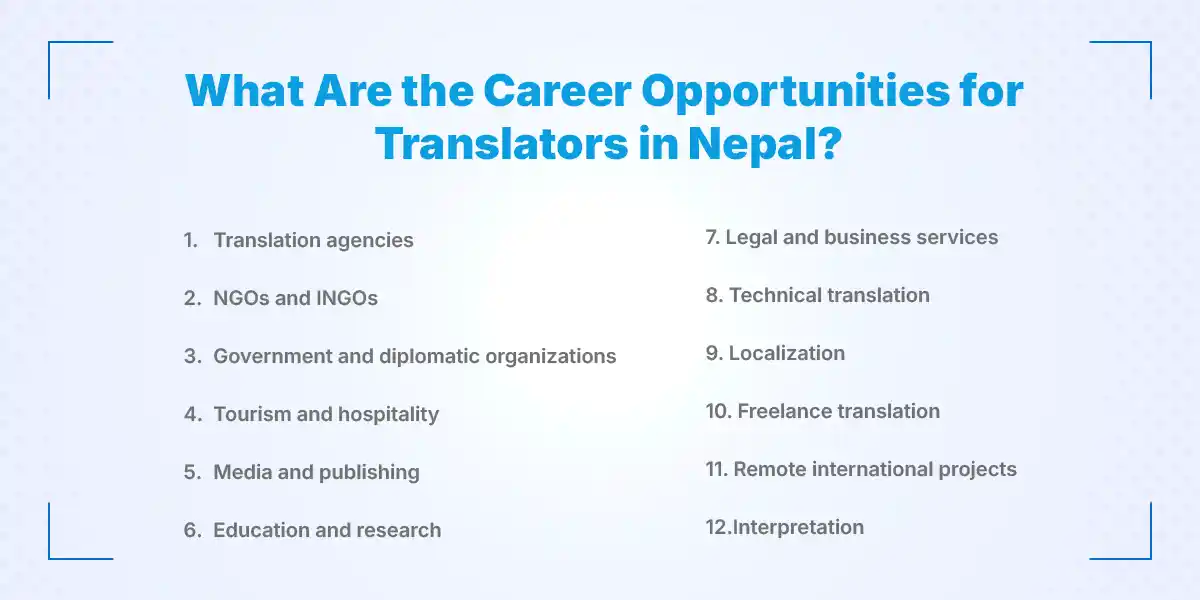
- Translation Agencies: Translators can work with agencies that provide document, business, website, and multilingual translation services.
- NGOs and INGOs: NGOs and INGOs hire translators to translate reports, project documents, training materials, and communication content.
- Government and Diplomatic Organizations: Translators can work with government offices, embassies, diplomatic missions, and international organizations.
- Tourism and Hospitality: Translators support hotels, travel agencies, tour operators, and tourism companies by translating travel content and communicating with international visitors.
- Media and Publishing: Translators can work with newspapers, magazines, publishers, television channels, and digital media companies.
- Education and Research: Translators can translate academic papers, textbooks, research reports, study materials, and educational resources.
- Legal and Business Services: Translators can provide services for contracts, legal documents, business agreements, certificates, and corporate communications.
- Technical Translation: Technical translators work on manuals, software documentation, product guides, engineering documents, and other specialized content.
- Localization: Translators can specialize in adapting websites, apps, software, games, and digital content for Nepali and international audiences.
- Freelance Translation: Freelancers can work independently with local clients, businesses, agencies, and international customers on a project basis.
- Remote International Projects: Skilled translators can work remotely for overseas companies and clients through online platforms and professional networks.
- Interpretation: Translators with strong speaking and listening skills can work as interpreters at conferences, meetings, business events, hospitals, courts, and diplomatic programs.
How Can You Increase Your Translator Salary in Nepal?
Translators who want to earn above the average rate in Nepal usually combine several strategies rather than relying on experience alone. Effective approaches include:
- Learning an additional high-demand language
- Specializing in legal, medical, technical, financial, or business translation
- Improving writing and proofreading precision
- Learning professional translation software and CAT tools
- Building a strong, visible portfolio
- Gaining consistent industry experience
- Developing a professional network within the language industry
- Earning relevant certifications or language proficiency test scores
- Exploring international and remote clients for higher-paying projects
- Improving freelance pricing and negotiation skills
Conclusion
Translator salaries in Nepal follow a clear pattern: pay rises with experience, specialization, and the rarity of a translator's language pair, moving from roughly NPR 18,000 for freshers to well over NPR 70,000 for senior, specialized professionals. The single biggest lever a translator controls is skill development, whether that means learning a high-demand language, mastering CAT tools, or specializing in legal or medical translation, since these choices directly determine which salary bracket a translator lands in over time.
Aspiring and current translators who build a strong portfolio, gain practical experience, and continuously sharpen their language and technical skills put themselves in the best position to command higher pay. Explore current translator and language-specialist openings across Nepal on KumariJob to find a role that matches your skill level and salary expectations.
Frequently Asked Questions
Submit your comments

Get Our App On



What Is the Average Music Producer Salary in Nepal?
VIEW DETAILS
What Is the Average University Professor Salary in Nepal?
VIEW DETAILS
What Is the Average Talent Acquisition Specialist Salary in Nepal?
VIEW DETAILS.webp)
What Are the 5 Mistakes That Slow Down Hiring in Nepal?
VIEW DETAILS


Loading Comments...