


.webp)

A strong candidate applies, goes quiet for two weeks waiting on feedback, and accepts a competitor's offer before the first interview is even scheduled. This happens to hiring teams across Nepal every week, and it rarely comes down to a weak talent pool. It comes down to a slow, unclear, or disorganized hiring process that pushes good candidates toward faster-moving employers.
This guide breaks down the five most common mistakes that slow down hiring in Nepal and shows exactly how to fix each one. By the end, employers will have a clear, practical framework for screening, interviewing, and hiring candidates before losing them to someone else.
In this blog
What Are the 5 Mistakes That Slow Down Hiring in Nepal?
The five biggest mistakes that slow down hiring in Nepal are unclear job descriptions, slow application screening, delayed interviews and decisions, unnecessary recruitment steps, and poor communication with candidates. Each of these creates friction at a different stage of the hiring funnel, and most companies are guilty of more than one at the same time. Fixing them does not require a bigger HR team, just a more disciplined process.
Writing unclear or incomplete job descriptions
Taking too long to screen applications
Delaying interviews and hiring decisions
Having too many unnecessary recruitment steps
Poor communication with candidates
Why Does Hiring Take So Long in Nepal?
Hiring takes so long in Nepal mainly because of unclear requirements, manual screening, and too many people involved in the final decision. These issues stack on top of each other, so a single vague job posting can trigger delays all the way through to the offer stage. The result is a hiring timeline that stretches far longer than the role actually requires.
- Unclear hiring requirements from the start
- Manual CV screening with no defined criteria
- Too many decision-makers involved in approvals
- Slow interview scheduling between candidates and interviewers
- Delayed feedback from hiring managers after interviews
- Lengthy approval processes before an offer goes out
- Poor candidate communication throughout the process
- Limited use of recruitment technology to speed things up
Mistake 1: Writing an Unclear Job Description
- Using vague job titles that do not match the actual role
- Not clearly explaining day-to-day responsibilities
- Missing required qualifications and skills
- Not mentioning salary or benefits when appropriate
- Adding unnecessary or inflated requirements
1. Why This Slows Down Hiring
An unclear job description attracts the wrong applicants, which forces the hiring team to sort through candidates who were never a fit in the first place. Vague titles and missing details also mean qualified candidates skip the posting because they cannot tell what the role actually involves. This adds days or weeks to the screening stage before a single interview happens. The problem compounds when recruiters have to go back and clarify requirements mid-process instead of getting them right upfront.
2. How to Fix It
Write the job description around what the person will actually do, using a specific title and a clear list of core responsibilities. State the required qualifications and skills directly, and include a salary range or benefits summary when the company policy allows it. Cut any requirement that is not truly necessary for someone to succeed in the role. A tighter, more honest job description filters in the right candidates and filters out the wrong ones automatically.
Mistake 2: Taking Too Long to Screen Applications
- Manually reviewing every application without a clear screening process
- Failing to define must-have qualifications before posting
- Spending too much time evaluating unsuitable candidates
- Not using applicant tracking or recruitment tools
1. Why This Slows Down Hiring
Without a defined screening process, every application gets the same amount of attention, whether the candidate is a strong fit or not. This wastes hours on resumes that should have been filtered out in seconds. Manual screening also introduces inconsistency, since different reviewers may judge the same resume differently. The longer screening takes, the more likely strong candidates accept another offer before they even reach an interview.
2. How to Fix It
Build a simple screening checklist based on must-have qualifications before the job goes live, so every reviewer applies the same standard. Prioritize candidates against those specific requirements instead of reading every application in full detail. Where possible, use applicant tracking tools to filter and rank candidates automatically. A defined checklist turns screening from a multi-day task into something that can happen within 24 to 48 hours of an application coming in.
Mistake 3: Delaying Interviews and Hiring Decisions
- Slow interview scheduling after shortlisting
- Too many interview rounds for the role's seniority
- Delayed feedback from interviewers after each round
- Waiting too long to extend an offer
1. Why This Slows Down Hiring
Every extra day between shortlisting and the interview is a day a candidate spends looking at other openings. Multiple interview rounds without a clear purpose add even more delay, especially when feedback from each round takes days to come back. Candidates in active job searches rarely wait around indefinitely for a company to make up its mind. Companies that move slowly at this stage consistently lose strong candidates to competitors who move faster with a similar offer.
2. How to Fix It
Set a clear deadline for scheduling interviews once a candidate is shortlisted, ideally within a few business days. Keep the number of interview rounds proportional to the seniority of the role instead of defaulting to a fixed process for every position. Assign one person the responsibility of collecting feedback and making the final call, rather than waiting for full team consensus. A fast, decisive process signals to strong candidates that the company is serious about hiring them.
Mistake 4: Creating Too Many Unnecessary Hiring Steps
- Multiple approval stages for a single hire
- Repeated interviews covering the same ground
- Unnecessary assessments unrelated to the role
- Too many people involved in the final decision
- Duplication between HR and department-level screening
1. Why This Slows Down Hiring
Every additional approval stage adds waiting time, even when the outcome of that stage rarely changes the final decision. Repeated interviews and duplicated screening between HR and the hiring department waste both the candidate's time and the company's. The more people involved in a decision, the harder it becomes to get everyone aligned quickly. Candidates notice when a process feels bloated, and it often signals internal disorganization rather than thoroughness.
2. How to Fix It
Review the current hiring workflow and identify which steps genuinely add value versus which ones exist out of habit. Combine or remove duplicate screening stages between HR and the hiring department wherever possible. Limit the number of people whose sign-off is required to only those with a real stake in the decision. A leaner process protects hiring quality while cutting out the delays that come from unnecessary steps.
Mistake 5: Poor Communication With Candidates
- Not acknowledging applications after they are submitted
- Delaying interview confirmations
- Failing to provide clear interview information
- Not updating candidates about hiring decisions
- Ignoring candidates after interviews are completed
- Sending unclear or incomplete communication
1. Why This Slows Down Hiring
Poor communication does not just frustrate candidates; it actively slows the process down because candidates disengage or accept other offers while waiting to hear back. Silence after an interview is often read as rejection, even when a decision has not been made yet. Unclear communication about next steps also creates confusion that leads to missed interviews or delayed responses. Companies with weak communication habits end up repeating outreach and rescheduling, which adds more delay on top of the original one.
2. How to Fix It
Acknowledge every application promptly, even with a short automated message confirming receipt. Send interview confirmations, timing, and format details as soon as they are finalized. Update candidates on their status after each stage, whether the news is positive or not. Maintaining regular, clear communication throughout the process keeps strong candidates engaged instead of letting them walk toward a competing offer.
How Can Companies Speed Up the Hiring Process in Nepal?
Companies in Nepal can speed up hiring by creating clear job requirements, using suitable job portals like KumariJob, screening CVs quickly, and reducing unnecessary hiring steps. A simple and well-organized recruitment process helps employers find qualified candidates faster and reduces the chance of losing skilled job seekers.
- Define the Job Clearly: Mention the required qualifications, skills, experience, and responsibilities before starting recruitment.
- Write a Clear Job Description: Use simple language and clearly explain what the candidate will do.
- Use Job Portals: Post vacancies on relevant platforms such as KumariJob to reach suitable candidates.
- Set Clear Screening Criteria: Decide which qualifications and skills are essential before reviewing CVs.
- Shortlist Quickly: Review applications and identify suitable candidates without unnecessary delays.
- Schedule Interviews Fast: Arrange interviews as soon as qualified candidates are shortlisted.
- Collect Feedback on Time: Ask interviewers to provide feedback quickly after each interview.
- Reduce Approval Steps: Remove unnecessary approval stages that can slow down the hiring process.
- Communicate Regularly: Keep candidates informed about interviews, results, and the next steps.
- Make Offers Quickly: Send the job offer promptly when the right candidate has been selected.
What Are the Best Hiring Practices for Employers in Nepal?
Employers in Nepal can make the recruitment process faster, fairer, and more effective by following these practical hiring practices
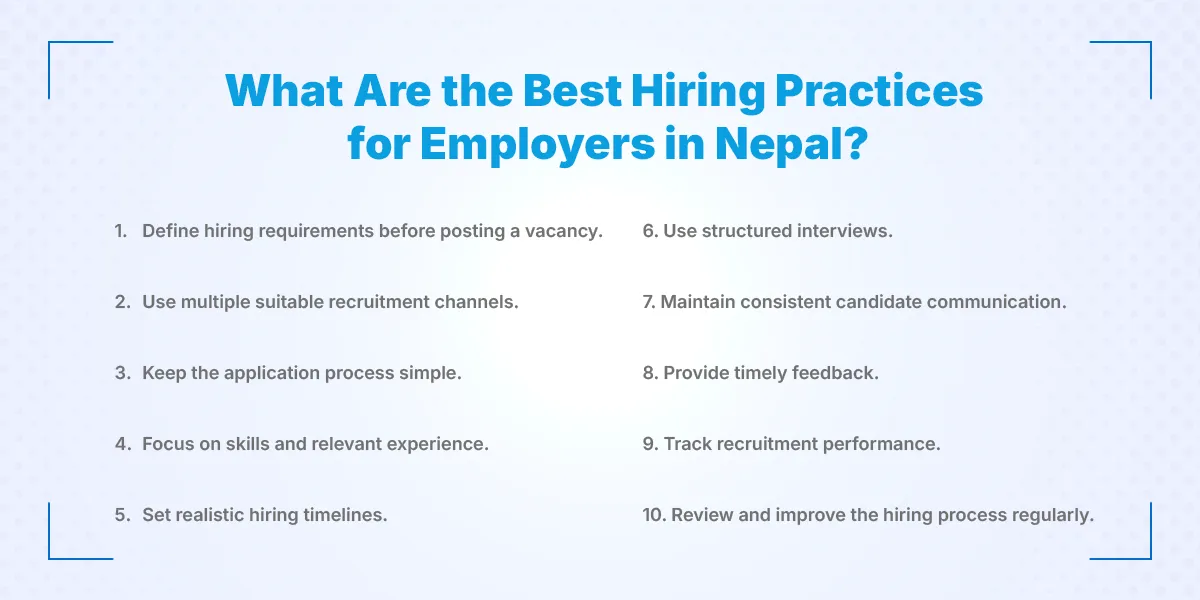
1. Define Clear Job Requirements
Before posting a vacancy, clearly identify the required qualifications, technical skills, soft skills, work experience, responsibilities, and other expectations so candidates understand whether they are suitable for the position.
2. Use the Right Recruitment Channels
Employers should use relevant recruitment platforms such as KumariJob, company career pages, professional networks, and industry-specific channels to reach qualified candidates and increase the chances of finding the right person quickly.
3. Keep the Application Process Simple
A simple application process allows qualified candidates to apply easily and reduces the chances of losing good applicants because of lengthy forms, unnecessary documents, or complicated application procedures.
4. Focus on Skills and Relevant Experience
Employers should evaluate candidates based on the skills, qualifications, practical knowledge, and relevant experience required for the position instead of focusing only on unnecessary requirements.
5. Set a Clear Hiring Timeline
Setting realistic deadlines for application screening, shortlisting, interviews, feedback, and final selection helps hiring teams stay organized and prevents unnecessary delays in the recruitment process.
6. Conduct Structured Interviews
Using a structured interview process with consistent, job-related questions helps employers compare candidates fairly, assess their abilities accurately, and make better hiring decisions.
7. Maintain Clear Candidate Communication
Employers should regularly communicate with candidates about application status, interview schedules, required documents, and next steps to create a professional and positive candidate experience.
8. Provide Timely Feedback
Providing interview feedback and hiring updates on time helps candidates understand their status and prevents qualified applicants from accepting opportunities with other companies while waiting for a decision.
9. Track Recruitment Performance
Employers should monitor important recruitment metrics such as time-to-hire, number of applications, interview-to-selection ratio, and candidate sources to identify problems and improve the hiring process.
10. Review and Improve the Hiring Process
Companies should regularly review their recruitment process, identify unnecessary steps or delays, collect feedback from candidates and hiring teams, and make improvements to create a faster and more efficient hiring experience.
How Can Technology Improve Hiring in Nepal?
Recruitment technology improves hiring in Nepal by reducing manual work, speeding up candidate screening, and keeping communication consistent. Instead of manually sorting resumes or tracking applicants in spreadsheets, HR teams can use dedicated tools to manage the entire pipeline in one place. This cuts down the time spent on repetitive tasks and frees up the team to focus on evaluating the strongest candidates.
- Online job portals, including KumariJob, to reach active job seekers
- Applicant tracking systems (ATS) to manage candidate pipelines
- Digital CV screening to filter applications faster
- Online interview platforms for remote or first-round interviews
- Automated interview scheduling to cut back-and-forth emails
- Candidate databases to revisit strong past applicants
- Recruitment analytics to identify where delays are happening
- Job alerts and notifications to reach candidates faster
- Digital communication tools to keep candidates updated automatically
How Does a Slow Hiring Process Affect Companies?
A slow hiring process can cause companies to lose qualified candidates, increase recruitment costs, and reduce productivity. When vacancies remain open for too long, existing employees may face additional workloads, while skilled candidates may accept offers from competing employers.
- Loss of Qualified Candidates: Skilled job seekers may accept another offer while waiting for a hiring decision.
- Increased Employee Workload: Existing employees may need to handle the responsibilities of vacant positions.
- Higher Recruitment Costs: Longer hiring periods can increase advertising, screening, interview, and HR costs.
- Longer Vacancy Periods: Important positions may remain unfilled for weeks or months, affecting business operations.
- Reduced Productivity: Staff shortages can slow down projects, customer service, and daily operations.
- Poor Candidate Experience: Delayed communication and unclear updates can create a negative impression of the company.
- More Competition for Skilled Workers: Other employers may hire qualified candidates faster.
- Negative Employer Reputation: A slow and unorganized recruitment process can affect how candidates view the company.
How Can Employers Create a Faster Hiring Process?
Employers can speed up hiring by creating a clear recruitment process, assigning responsibilities, setting deadlines, and using suitable job platforms such as KumariJob. A simple and organized process helps companies reduce delays and hire qualified candidates faster.
Simple Hiring Workflow:
Job Requirement → Job Posting → Application Screening → Shortlisting → Interview → Evaluation → Selection → Job Offer → Onboarding
- Set Clear Responsibilities: Assign a specific person or team to manage each hiring stage.
- Set Hiring Deadlines: Decide how much time should be spent on screening, interviews, feedback, and final selection.
- Track Candidates: Keep records of applications and candidate progress throughout the recruitment process.
- Use Recruitment Tools: Use job portals, ATS, and digital tools to reduce manual work.
- Communicate Quickly: Respond to candidates and provide updates without unnecessary delays.
- Remove Unnecessary Steps: Review the hiring process regularly and remove steps that do not add value.
Conclusion
The five mistakes covered here- unclear job descriptions, slow screening, delayed interviews, unnecessary steps, and poor communication- all point to the same root problem: a hiring process without clear ownership and deadlines. Fixing that problem does not require a complete overhaul. It requires assigning responsibility at each stage, setting realistic timelines, and communicating with candidates consistently enough that they stay engaged until an offer is made.
Employers ready to hire faster and reach more qualified candidates can post vacancies directly on KumariJob to connect with job seekers actively searching for roles in Nepal.
Frequently Asked Questions
Submit your comments

Get Our App On



What Is the Average University Professor Salary in Nepal?
VIEW DETAILS
What Is the Average Talent Acquisition Specialist Salary in Nepal?
VIEW DETAILS
What Is the Salary of a Hydropower Plant Operator in Nepal?
VIEW DETAILS
What Is the Average Audiologist Salary in Nepal in 2026?
VIEW DETAILS


Loading Comments...